The Accountability Record
You did the right thing. Now you can show it.
Doing right by a tenant is one thing. Showing it a year later is another. Here is how Harthing keeps that proof, and why it is built the way it is.
Two rules, one answer
Section 21 went on 1 May 2026. Possession now runs through Section 8, where the outcome turns on the quality of your evidence. The question stopped being whether you are a reasonable landlord and became whether you can show it: when the tenant told you, what you did, when you did it, who you sent, what it cost.
At the same time HMRC wants your figures kept digitally as you go, rather than assembled in January. Two different rules, asking for the same thing: a record kept at the time. Harthing keeps one record that answers both.
A numbered list of things that happened
Every property has a record. It is a numbered list of things that happened, in the order they happened, with the time each one was written. Adding a document writes a line. Changing a status writes a line. Recording a cost writes a line. There is no separate form to fill in. The record builds up from the things you were doing anyway.
Nothing is removed
Everyone gets a figure wrong now and then. When you do, you correct it, and the correction goes on the record as a new line with its own time. Nothing earlier is removed. That is what makes the record believable: anyone reading it can see that a correction was made, and when.
Dated by the system, not by memory
The time on each line is set by Harthing at the moment the line is written. You never type it, so you never have to remember it, and nobody reading the record has to take it on trust. If you are ever asked when you logged a problem, the answer is already there, to the minute.
Each line holds the one before it
Each entry carries a short fingerprint calculated from its own contents and from the fingerprint of the entry before it. The entries are therefore a chain. Change one word in entry forty and its fingerprint changes, which breaks the link to entry forty one, and to every link after that. Harthing recalculates the whole chain each time you open the record, and tells you what it found.
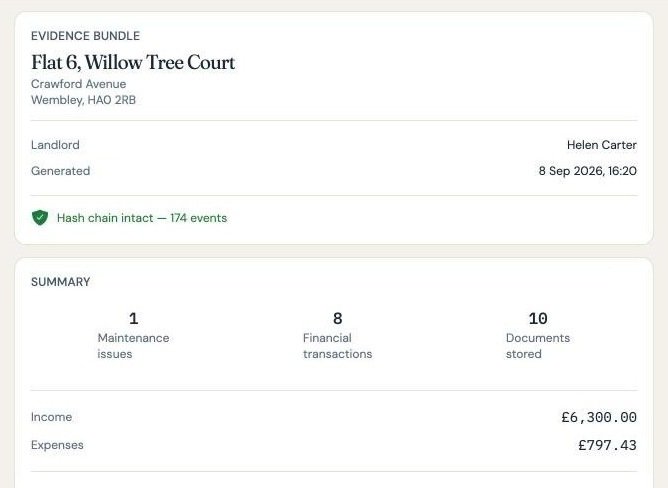
In practice you see one line at the top of the page: hash chain intact, and the number of events. The same line is printed at the top of the evidence bundle.
One document, ready to hand over
When you need to show it, you export it. The bundle is one document for one property: a summary of the property and the tenancy, the numbered ledger in full, the documents, the financial summary, and the verification line. It is meant to be printed and handed across a table, attached to a form, or sent to a solicitor.
Six lines nobody had to write
A torn sofa is found at Flat 5. Here is what the record holds afterwards.
Read top to bottom, those six lines show the problem was logged on 24 August, a contractor was assigned the next day, and the repair was finished nine days later, with the invoice attached. If anyone asks later what you did about it, and when, that is the answer, and you did not have to write any of it up.
The honest limits
The record shows what you did and when. It does not say that what you did was enough. A line showing you uploaded a gas safety record does not make the certificate valid, and a line showing you sent a contractor does not mean you sent one quickly enough. Harthing is not a compliance service, and it is not legal or tax advice.
What it gives you is a straight answer to the question of what happened, with dates on it.
Why that matters to your tenant too
A good record is fair to both people in a tenancy. Because nothing on it changes after the event, a bundle you share with your tenant shows them the same dated facts you are looking at, which is a far calmer place to start than two memories.