Dashboard
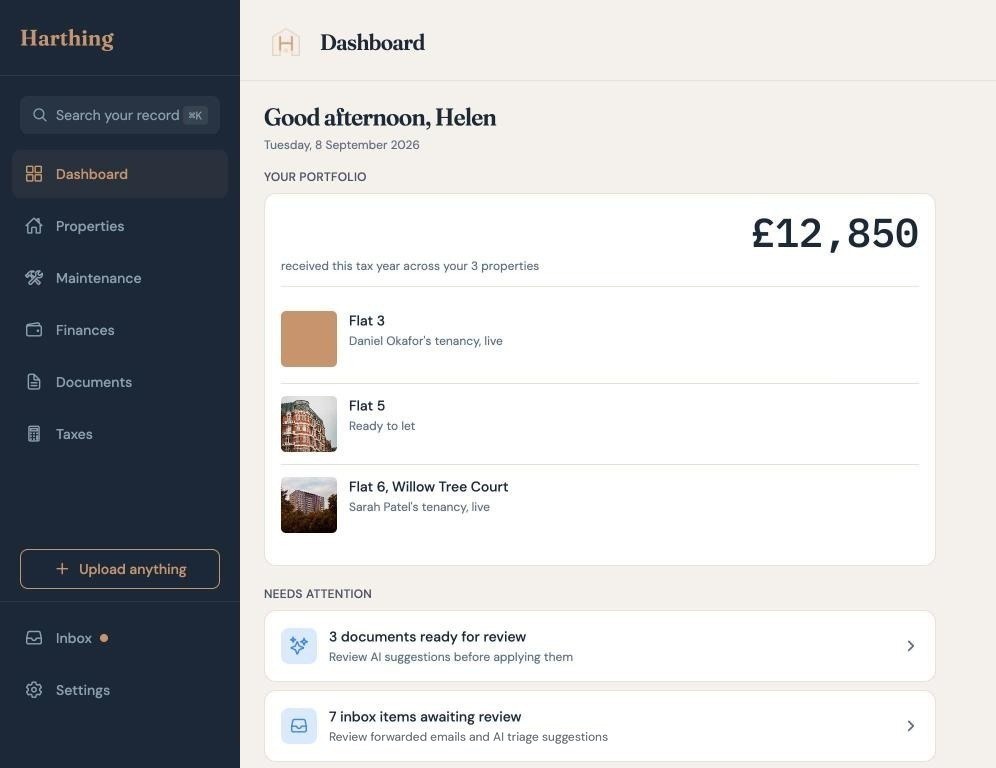
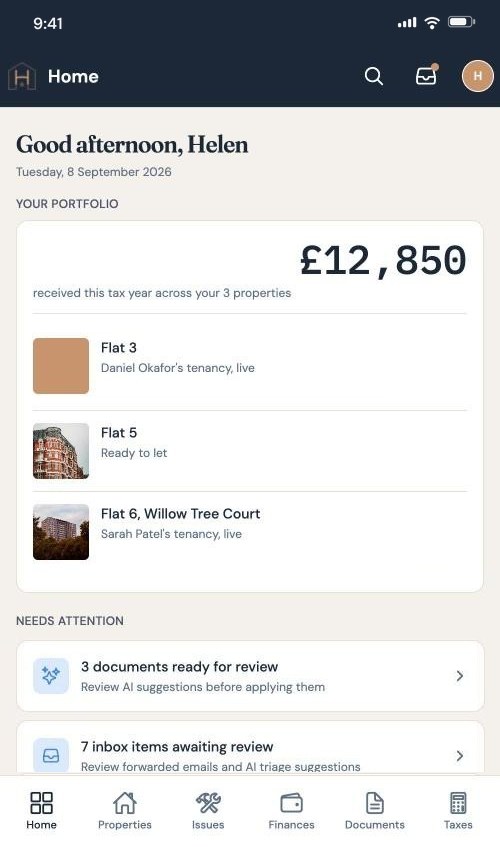
One screen: every property with who is living there, what has come in this tax year, and a list of anything waiting for you, such as documents to check.
For landlords with a property or two
Good letting, on the record.
Harthing is one quiet place for everything to do with letting a home. The certificates, the repairs, the money, the tax. You look after the property the way you always have. The record builds itself while you do it, so that if anyone ever asks you to show what happened and when, you can.
Four things have changed for landlords, or are about to. None of them were your doing. All of them are now yours to deal with.
Three in four landlords missed the first Making Tax Digital deadline. HMRC is now enrolling them automatically.
Making Tax Digital runs on quarterly updates. From April 2027 each missed update earns a penalty point, and four points bring a £200 penalty.
Possession now runs through Section 8, and Section 8 turns on the quality of your evidence.
It launches in the West Midlands on 15 December 2026 and reaches the rest of England over the following twelve months. Once the penalties are in force, they go up to £7,000.
This is what the record looks like from the inside. Every line is written when the thing happens, and stays exactly as it was written.
You type the postcode and pick the address off the list. From that minute the property exists, with its own page and its own colour.
You drag in the documents you have not looked at since you filed them. Harthing reads each one, works out what it is and which property it belongs to, and shows you what it found so you can confirm it or correct it. The expiry goes in the diary at the same time.
You connect your bank, and the rent arriving and the bills leaving come in on their own, sorted into the categories HMRC uses. From here your quarterly update drafts itself as you go, and you send it to HMRC from Harthing when it is due.
By the end of the first sitting you have a record. From then on it fills in as you go.
Read how it works →One screen: every property with who is living there, what has come in this tax year, and a list of anything waiting for you, such as documents to check.
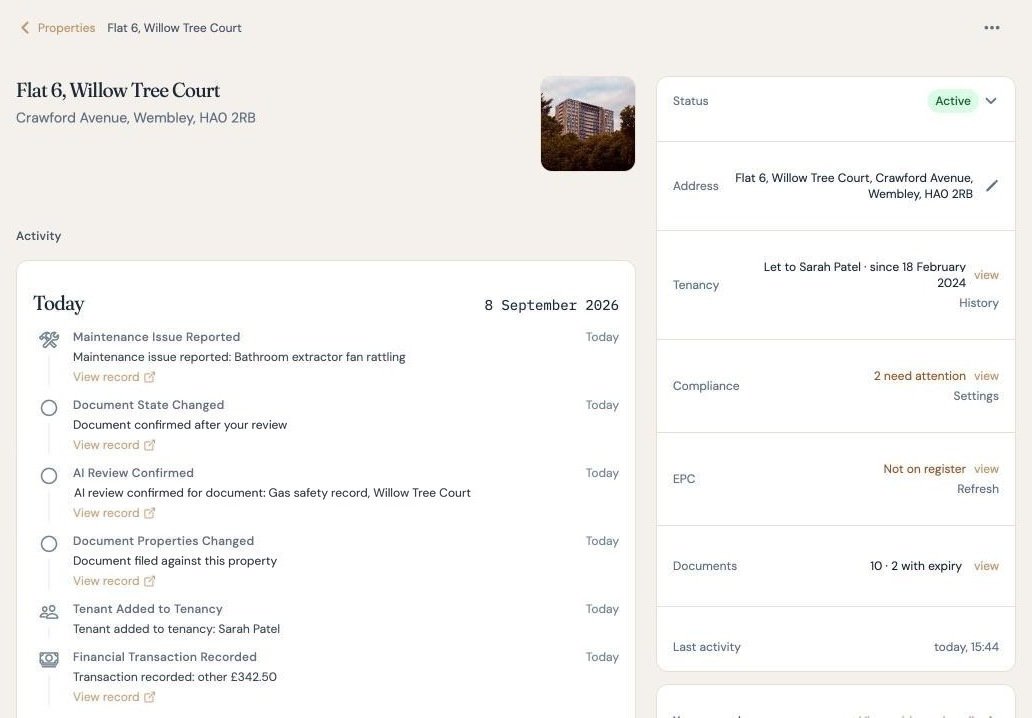
The photograph, the tenancy, the certificates with their expiry dates, and every repair, payment and document in the order it happened. If you sell one, you archive it with a reason, and its record stays exactly as it was.
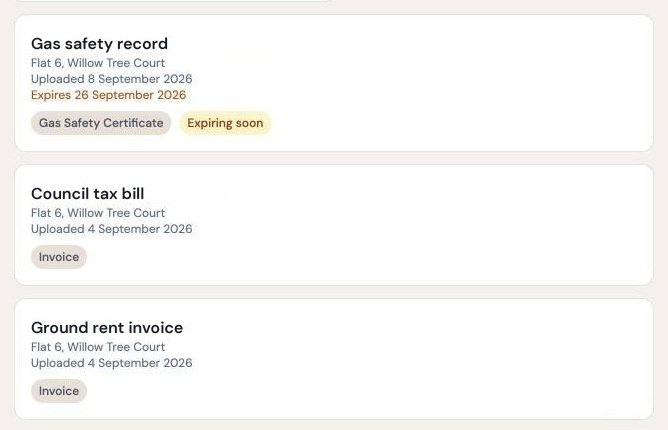
Every certificate, agreement and invoice, filed against the property it belongs to. Each one is read when it arrives and the dates are pulled out, so anything close to expiry is marked and in the diary.
Forward an email, upload a scanned letter, or drop in a file. Each one is read, matched to a property and put in front of you to confirm or correct, as a document or as a transaction.
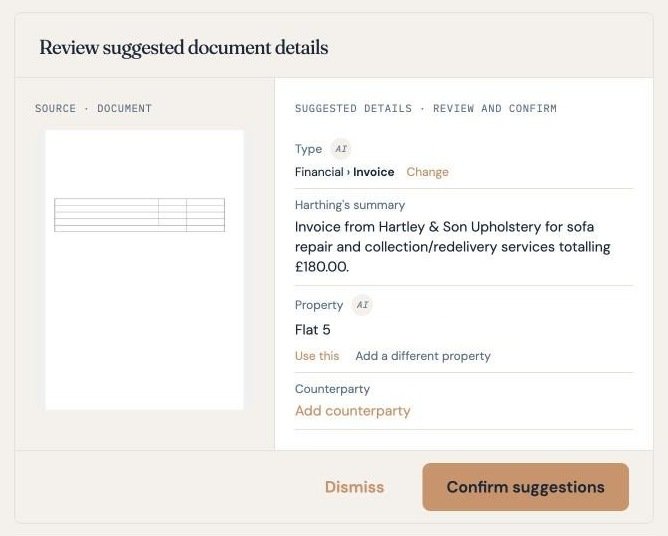
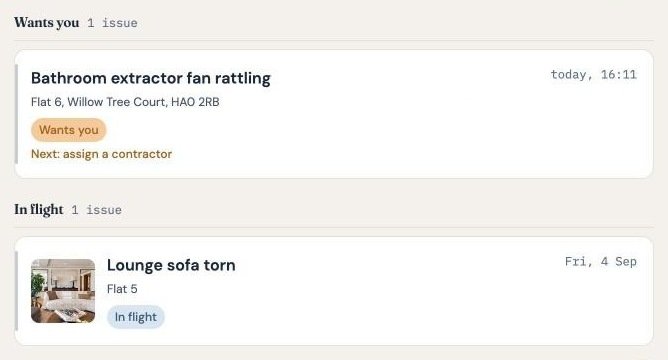
Log the problem when the tenant tells you about it, with a photograph if there is one. Assign the contractor. Mark it scheduled when a date is agreed, and done when it is done. If you decide not to act, you say why, and that stays on the record too. Every step is stamped with the time it was taken.
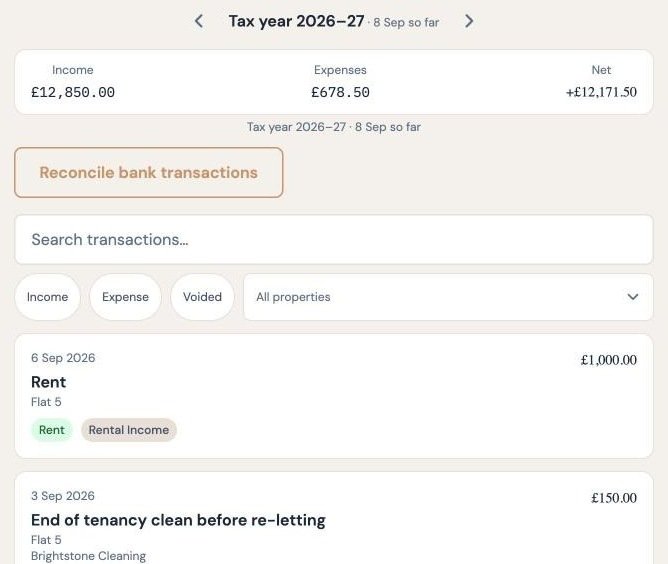
Rent in, costs out, each one tagged to a property and to an HMRC category. Most of it arrives on its own from your bank. A receipt or invoice you upload or forward is read and offered back to you as a transaction to confirm. You can open any one of them and change anything. The change goes on the record with the time it was made.
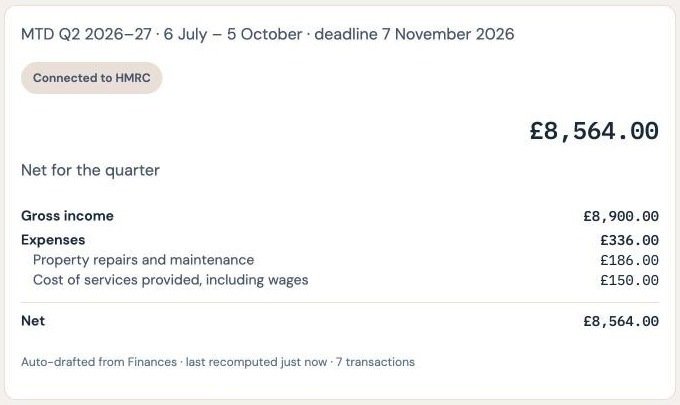
Your quarterly update drafts itself as the quarter goes along, with the deadline and the net figure in view. When you are ready, you connect to HMRC and send it. Harthing files your quarterly updates, not your end of year tax return, which covers income Harthing never sees. You can export the year’s records and file that in your usual way.
The Accountability Record
Everything above lands in one continuous record for each property. Entries are added, never edited and never removed. Each one is stamped with the time it was made and carries a fingerprint of the entry before it, so if a single line were altered the chain would not add up, and Harthing would say so. When you need to show your side of things, you export the lot as one document.
Read how the record works →Making Tax Digital
HMRC closed the door to new tax filing software for this year in August. Harthing came through it.
Harthing is recognised by HMRC for Making Tax Digital quarterly updates, and files them for you. Your end of year tax return is separate, because it covers income Harthing never sees. The next quarterly update is due on 7 November 2026. In April 2027 the threshold drops to £30,000, counting your property and any self-employed income together, before expenses. Penalty points for missed updates begin at the same time.
Pricing
Every band has everything in it. The band is about how many properties you have, not how much of Harthing you are allowed.
The flat you kept, or the one that came to you. Everything Harthing does, for one or two homes.
Enough properties that you started keeping a spreadsheet, and enough that the spreadsheet has started to worry you.
A small portfolio, run properly, by you.
You do not need to be ready. Put in one property, drop in whatever you kept, and let the rest arrive over the next few weeks.
Add your first property